Wood flooring is often chosen by feel, appearance and price. These are all important, but they do not tell the whole story. A floor is one of the largest surfaces in a home and a long-term investment. That is why it is worth looking at the full lifecycle: how long the floor will serve, how it can be maintained, and what happens when the surface wears over time.
Hardened wood flooring can be more affordable to buy than parquet flooring. The strength of parquet, however, becomes clear in long-term use. A high-quality parquet floor can be maintained, retreated and, when needed, sanded. This can significantly extend the service life of the floor and spread the investment over several decades.
When flooring is viewed through lifecycle thinking, the most important question is not only “what does the floor cost now?”. A more useful question is: how long can the floor remain a good, repairable and valuable part of the space?
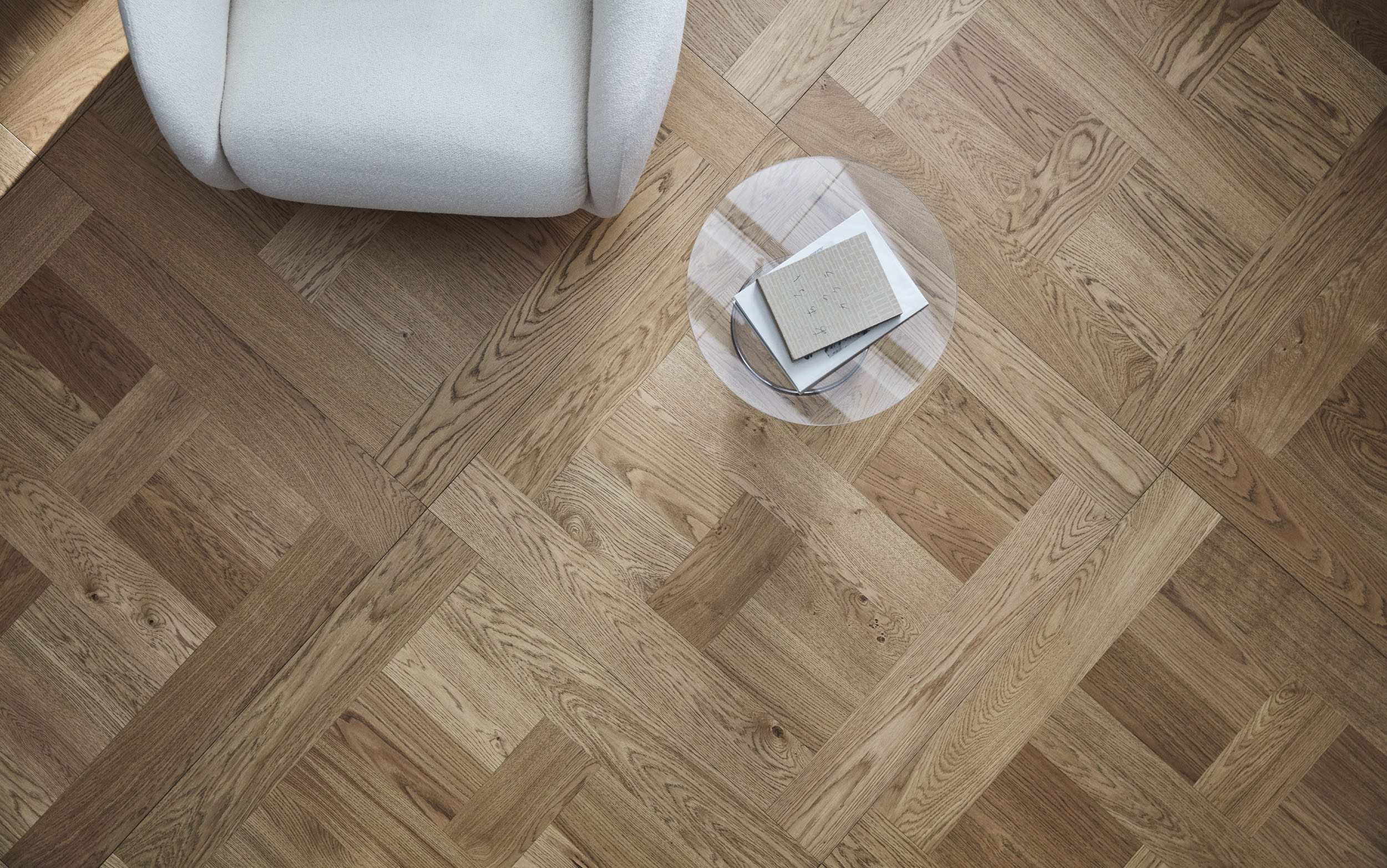
What is the difference between parquet and hardened wood flooring?
Parquet is a real wood floor with a wooden top layer and a multi-layer structure beneath it. Timberwise parquet is a three-layer plank parquet floor. For example, Timberwise oak parquet has a total thickness of 14 mm and a wear layer of 3.0 mm +/- 0.3 mm.
In this article, hardened wood flooring refers to floors where a wood surface is combined with a hardened structure or a wood-based composite structure. Their advantage is often a hard surface with good resistance to everyday wear. However, many manufacturers’ instructions for hardened wood floors state that the floor must not be sanded.
The difference is therefore not only about which surface resists dents better in daily life. The real difference is what can be done to the floor once the surface has become worn, scratched or outdated in tone after years of use. Many people search for “parquet or hardened wood flooring” or look for experiences of hardened wood floors. When comparing the two, it is worth considering surface hardness, but also the service life, sanding and maintainability of parquet.
Short answer: the benefit of parquet is repairability
If the choice is based only on purchase price, hardened wood flooring can feel attractive. If the choice is viewed through the full lifecycle, the advantage of parquet is its maintainability and sandability.
In Timberwise’s EPD, the reference service life of multi-layer parquet is stated as 40 years when the floor is correctly installed and maintained. The same EPD states that, with proper maintenance, the service life of multi-layer parquet can be considerably longer. According to the EPD, a floating installation also enables reuse, and the floor can be sanded 1-2 times to extend its lifecycle.
This is an essential difference compared with many hardened wood floors. A hardened wood floor can be hard and durable in everyday use, but if it cannot be sanded, its lifecycle depends more on the original surface remaining in good condition, local repairs and possible board replacement.
Comparison: parquet and hardened wood flooring from a lifecycle perspective
| Feature | Parquet flooring | Hardened wood flooring |
|---|---|---|
| Purchase price | Often higher | Often more affordable |
| Surface | Real wooden wear layer | Thin wood surface or hardened wood-based structure |
| Sandability | Possible depending on the product and condition | Usually not sandable |
| Maintainability | Cleaning, care, retreatment and sanding | Cleaning, local repairs or board replacement |
| Lifecycle thinking | Service life can be extended through renovation | Service life is largely based on the durability of the original surface |
| Long-term cost | Purchase cost is spread over a longer period | Initial price may be lower, but wider wear can lead to replacement |
| Especially suitable for | Homes and projects where long service life and repairability are valued | Projects where a hard surface and lower initial investment are priorities |
Why does sandability affect the true cost of a floor?
wood floor does not wear evenly. Hallways, kitchens, walkways and areas around workstations often face more stress than quieter rooms. Over the years, the floor may develop scratches, dents, wear and changes in tone.
If the floor cannot be sanded, the options are more limited. Smaller damage can be repaired locally, and in some cases individual boards can be replaced. Wider wear, however, may mean that the whole floor begins to look tired before its technical service life would otherwise be over.
With parquet, the situation is different. When there is enough real wood on the surface, the floor can be renovated. Sanding and a new surface treatment can refresh the appearance of the floor and extend its service life. At the same time, the tone and surface treatment can be reassessed.
This is why the higher purchase price of parquet can be spread over a longer period. The floor does not have to be seen only as a purchase, but as a material that can be maintained.
Wear layer thickness is more than a technical detail
The wear layer of Timberwise oak parquet is 3.0 mm +/- 0.3 mm. This matters because the wear layer gives the floor both its genuine wood surface and its renovation potential.
The wear layer is the part of the floor you see and feel. It takes on everyday use, light, furniture marks and the natural movement of wood. When the surface layer is thick enough, the floor can be cared for and renovated in a way that is not possible with all thinner or hardened structures.
A hardened wood floor can have a very hard surface. Hardness is a benefit in use, but it is not the same as sandability. The long life of a floor is not created only by how well the surface performs during the first years. It is also created by whether the floor can be repaired and renewed later.
Moisture Resistance Matters in Everyday Spaces
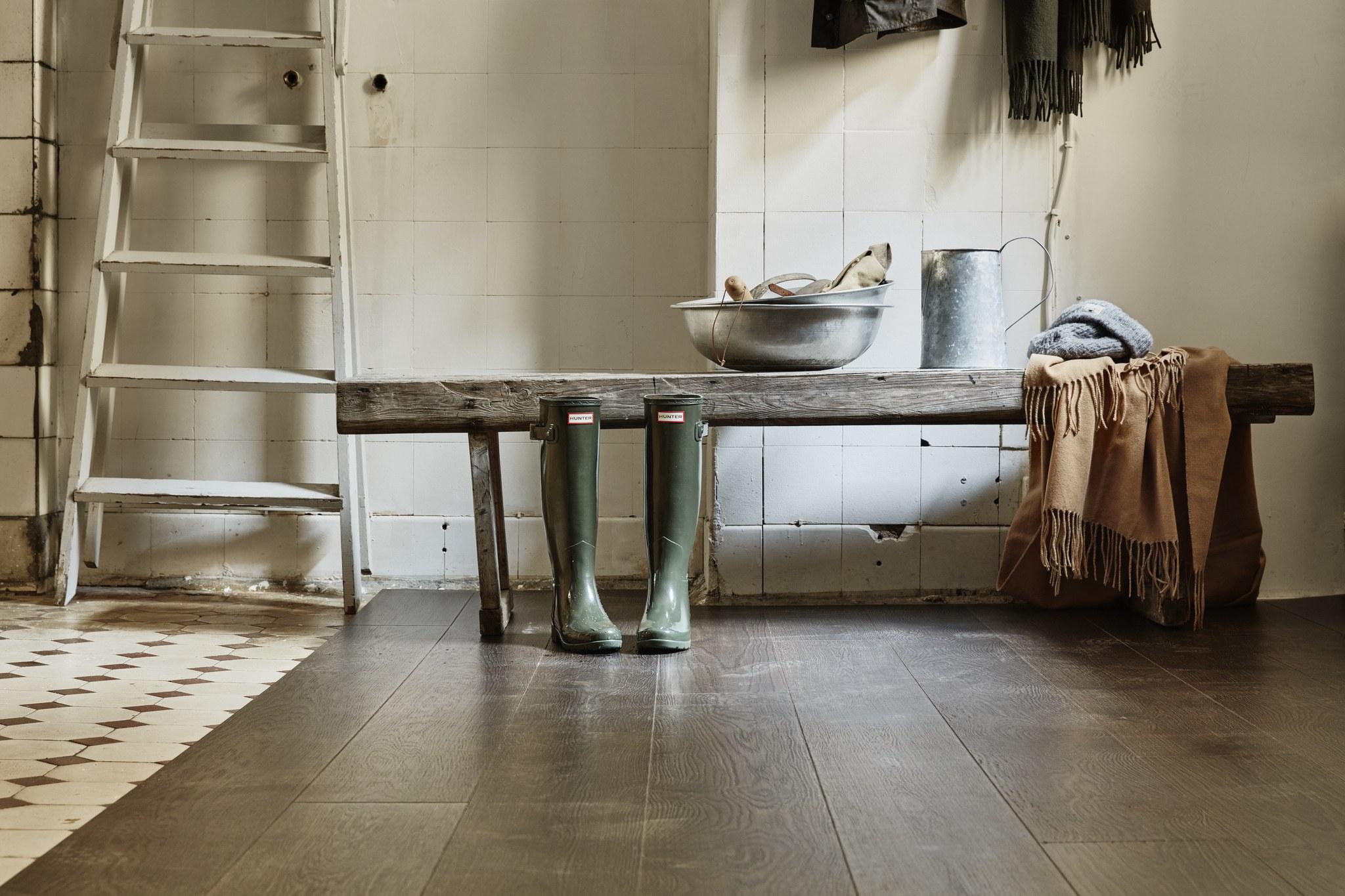
The structure of the floor is especially important in spaces where water, dirt or moisture may end up on the surface. In kitchens, hallways and other high-traffic areas, the floor often faces heavier wear than in living rooms or bedrooms.
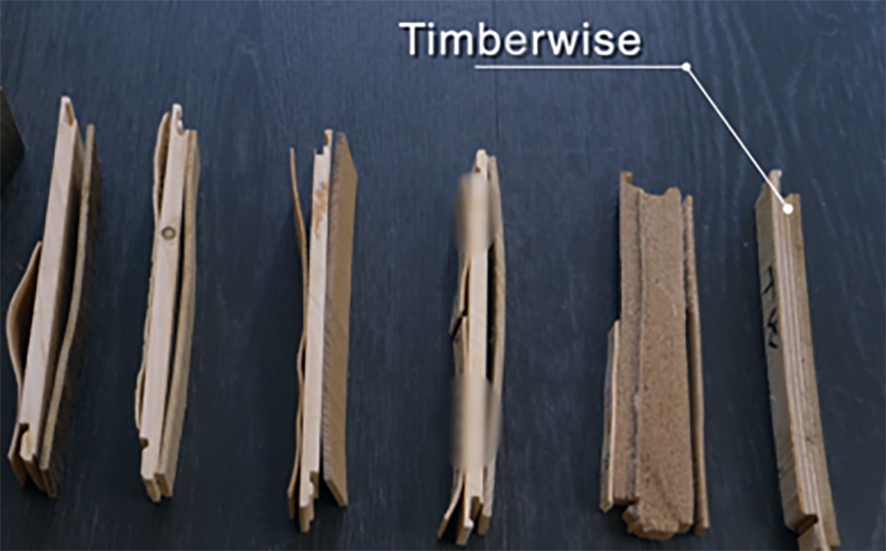
Timberwise parquet uses birch plywood as its middle layer. From a moisture-resistance perspective, this makes the structure more reliable than the HDF core used in many hardened wood floors, as HDF is sensitive to moisture and water splashes. The joints of Timberwise parquet are also treated with moisture-repellent wax to help protect the seams.
The glue joints also play an important role. Timberwise parquet glue joints meet the demanding JAS2 standard and even pass a boiling test, demonstrating the durability of the bonded structure. In everyday use, this brings added peace of mind: if water is splashed onto the floor, it does not automatically mean damage, as long as any standing water is wiped away within a reasonable time.
This is why moisture resistance is an important point of comparison, especially when choosing flooring for kitchens, hallways or other active areas of the home.
What does an EPD tell us about the lifecycle of flooring?
An EPD, or Environmental Product Declaration, is a third-party verified environmental declaration. It is not an advertising claim, but a standardised way to describe a product’s environmental impacts according to defined calculation rules.
According to Timberwise’s EPD, the declared unit for multi-layer parquet is 1 m2 and the product mass is 9.7 kg/m2. The product is 97% bio-based by raw material content. In the EPD, the fossil global warming potential for modules A1-A3, meaning raw materials, transport and manufacturing, is stated as 15.3 kg CO2e/m2. The total GWP value for A1-A3 is 1.06 kg CO2e/m2 when biogenic carbon is accounted for according to the standard.
These figures should not be taken out of context. EPDs are not always directly comparable, even when they appear similar in a table. Differences may come from the product structure, mass, place of manufacture, transport assumptions, service life and which lifecycle modules have been declared.
For consumers and professionals, the most important message of an EPD is this: the environmental impacts of flooring should be assessed together with service life, maintainability and the need for replacement.

A long service life is an environmental choice
Manufacturing a floor always causes environmental impacts. This is why a long service life is an important part of responsible material selection.
If a floor is replaced early, a new manufacturing, transport, demolition and waste phase is created. If the same floor can instead be maintained and renovated, the need for replacement can be postponed. This is the core of lifecycle thinking.
In Timberwise’s EPD, the reference service life of multi-layer parquet is 40 years when correctly installed and maintained. The EPD also highlights the possibility of extending the service life through sanding, as well as the fact that a floating installation may allow the floor to be reused. These are practical matters, not just environmental reporting terms.
A long-lasting floor also makes everyday life easier. Renovating a floor is a major project that affects living, schedules and the use of the space. The longer the same floor can remain in use, the less often heavy renovation is needed.
What about the environmental figures of hardened wood floors?
Hardened wood floors have their own strengths. Comparison EPDs show, for example, efficient use of wood raw material, a hard surface and a wood-based structure.
This alone, however, does not determine the overall responsibility of a flooring choice. If the product cannot be sanded, the lifecycle must be assessed differently. In that case, the key questions are how well the surface remains in good condition, whether individual boards can be replaced, and how easily the floor can be dismantled, reused or recovered at the end of its lifecycle.
With parquet, the strength lies in the combination of repairability and material longevity. This may not always be visible in a single A1-A3 figure, but it is visible in how long the floor can continue to serve.
For consumers: look at the price over years, not only per square metre
The square metre price of a floor is easy to compare. But it does not tell you which floor is the smartest choice in the long term.
If a more affordable floor needs to be replaced earlier, the original saving may shrink or disappear altogether. If a high-quality parquet floor can be renovated and brought back into use with a new surface treatment, its cost is spread over a longer period.
When choosing a floor, consumers should ask at least these questions:
- Can the floor be sanded?
- Can the surface be retreated?
- How is the floor maintained?
- What happens if the surface wears in walkways?
- What service life is stated for the product?
- Does the product have an EPD?
Answering these questions makes the choice calmer and more informed.
For professionals: EPD and repairability support each other
For designers, construction companies and retailers, an EPD is an important tool. It helps assess the environmental impacts of a product in a standardised way and supports responsible material selection.
At the same time, it is important to remember that an EPD alone does not describe the full value of a product during use. Maintainability, repairability and the possibility of extending service life all affect how well the material performs in a project over time.
Parquet is a reliable choice for professionals when long service life, natural material and the possibility of later renovation are valued. This is especially relevant in homes, high-quality residential projects, hotels, offices and other spaces where the floor is expected to remain valuable for a long time.
Timberwise parquet care supports a long service life
A long service life is not created by the product alone, but also by correct care. Timberwise parquet is easy to maintain when the basics are remembered.
The floor should be kept clean by regular vacuuming. For wiping, use a damp, not wet, mop. Standing water should be removed immediately. Felt pads should be used under furniture legs, and the floor should be properly protected when heavy furniture is moved.
Indoor conditions also matter. According to Timberwise instructions, the suitable relative humidity for parquet is 35-60% and the temperature should be +18-24 °C. When conditions remain suitable, the natural movement of wood stays more controlled and the floor remains in better condition.
Summary: parquet is not a floor that needs to be treated as disposable
Hardened wood flooring can be a good solution when a hard surface and a lower initial investment are priorities. Parquet is a strong choice when long service life, the feel of real wood and the possibility of renovating the surface years later are expected from the floor.
The advantage of Timberwise parquet comes from the whole: a real wood surface, a 3.0 mm +/- 0.3 mm wear layer, a three-layer structure, maintainability and the long service life described in the EPD. When the floor can be sanded 1-2 times and its lifecycle can be extended through correct care, the purchase cost is spread over a long period.
That is why flooring should not be chosen only by what looks most affordable at the time of purchase. A good floor is chosen by how it stands up to time, use and life.
Considering a wood floor for your home or project?
Explore Timberwise parquet options and order samples. When you can see the tone, surface and natural variation of wood in your own space, it is easier to make a choice that lasts.

Frequently asked questions
Which is better, hardened wood flooring or parquet?
It depends on the intended use. Hardened wood flooring can be more affordable to buy and may have a very hard surface. Parquet is a strong choice if you value maintainability, sandability and a long lifecycle.
Can Timberwise parquet be sanded?
According to Timberwise’s EPD, multi-layer parquet can be sanded 1-2 times to extend its service life. The possibility of sanding should always be assessed based on the condition of the floor, the product and professional judgement.
Can hardened wood flooring be sanded?
Many hardened wood floors must not be sanded. Manufacturers often prohibit sanding because it can remove or damage the hardened surface and protective surface treatment.
What does EPD mean?
EPD stands for Environmental Product Declaration. It is an environmental declaration that describes a product’s environmental impacts in a standardised way. It helps compare products, but comparisons must be made carefully because product boundaries, service lives and structures may differ.
Why is a long service life important for the environment?
The longer a floor can remain in use, the less often new manufacturing, transport, demolition and installation are needed. A maintainable and repairable floor can therefore be a sensible choice from a lifecycle perspective.
Is parquet always more expensive than hardened wood flooring?
The purchase price of parquet can be higher. In the long term, however, what matters is how long the floor lasts in use and whether it can be renovated. A sandable and maintainable parquet floor can spread the cost over several decades.
What is the difference between hardened wood flooring and parquet?
Hardened wood flooring is based on a hardened surface structure, while parquet has a real wooden wear layer. The benefit of parquet is that, depending on the product and its condition, it can be sanded and retreated.
Is parquet suitable for underfloor heating?
Timberwise parquet is suitable for underfloor heating when the installation and maintenance instructions are followed. The floor surface temperature must not rise too high, and indoor conditions should remain suitable for a wood floor.